
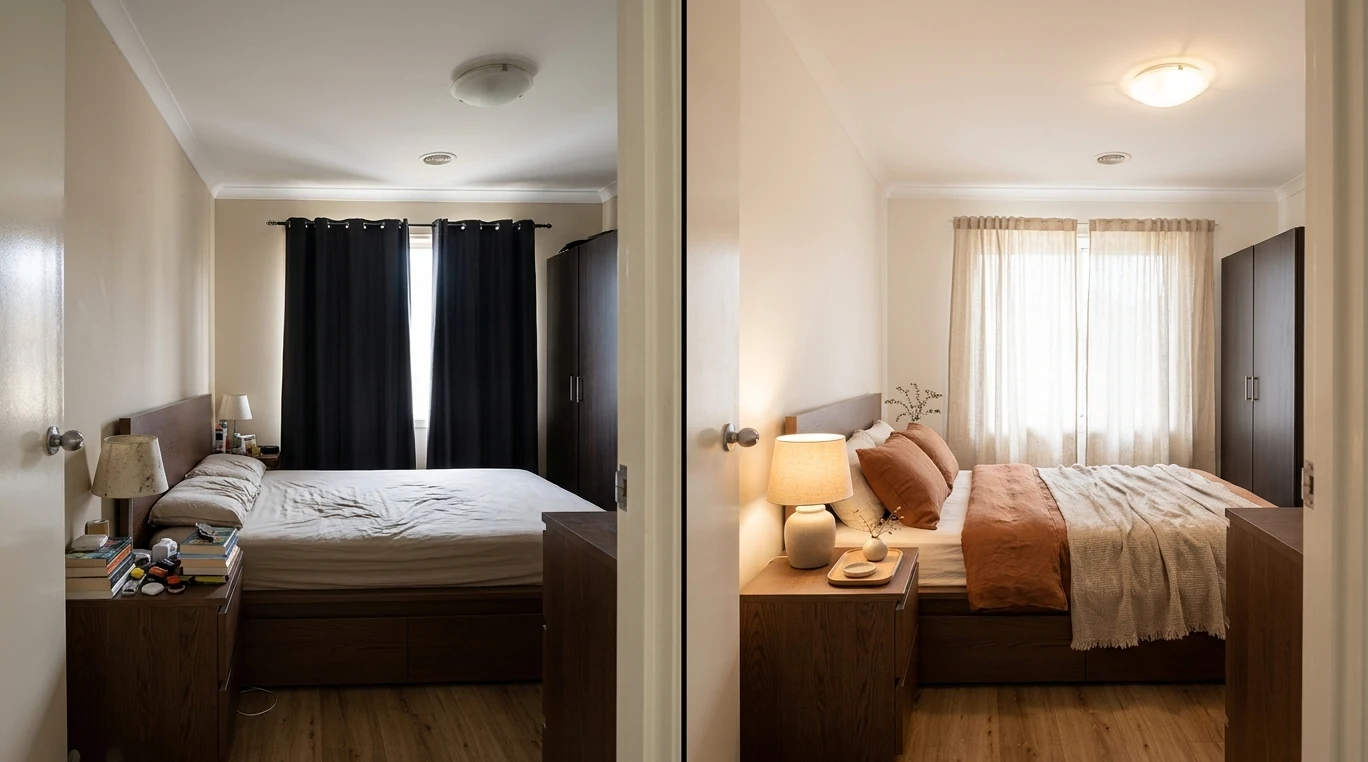
Our bedroom had been in a holding pattern since we moved in four years ago. Mismatched furniture from three different IKEA eras - a PAX wardrobe from 2018, a MALM bed frame from the apartment before that, a bedside table that came from my parents' house and was never meant to stay. Beige walls that were already there when we arrived and that we'd never gotten around to questioning. A ceiling light with a shade we'd bought on clearance and had been meaning to replace since approximately forever.
Nothing was broken. Nothing was ugly exactly. It just didn't feel like a room we'd chosen - it felt like a room that had accumulated around us.
We finally fixed it in two weekends. Total spend: $260. Here's what we did and what we'd do differently.
What We Wanted to Change
Writing down the actual problems helped more than I expected. Ours came down to three things.
The lighting was the biggest issue. One overhead fixture in the center of the ceiling meant the room was either fully lit or fully dark. No warmth, no variation, nothing that made it feel like a place to wind down. Every lamp photo I saved had at least two light sources and neither of them was directly overhead.
The color was the second problem. Beige walls with a white ceiling and white trim - technically fine, but flat in a way that made everything in the room look slightly washed out. The furniture had warm wood tones that were fighting the cool neutrality of the walls.
Visual clutter was the third thing. Not mess exactly - the room was reasonably tidy - but too many objects in competing styles. The bedside table had a stack of books, a glass of water, a phone charger, a lamp from one era, and a small succulent in a terracotta pot. None of it was wrong individually. Together it read as unsettled.
What we specifically didn't plan to fix: the bed frame, the wardrobe, or the flooring. Too expensive for this round. The goal was to make what we had look like it belonged together.
Planning the Redesign Without Spending Anything
Before we moved a single thing, I spent an afternoon running our bedroom photo through an AI bedroom design tool to test directions I'd been debating.
I'd been going back and forth between two approaches. Option one: lean into the warm wood tones of the existing furniture - a deeper wall color, warmer textiles, amber lighting. Option two: go lighter and cooler, let the furniture be the warm element against a more neutral backdrop.
I ran both. The warmer direction looked heavier in our room than I'd imagined - good in theory, slightly oppressive given how much furniture we have and how little floor space is visible. The lighter approach worked better than I expected. Off-white walls with warm lighting in the corners did something I hadn't anticipated: they made the MALM bed frame look like it had always been the right choice.
I also tested three different headboard arrangements - one centered on the wall, one offset to the left (our current position), and one with the bed rotated 90 degrees toward the window. The rotation didn't work at all; I'd suspected it might not but wanted to see it confirmed before moving a heavy frame for nothing.
If you're thinking about selling at some point and want to see how the room reads as a listing, the AI virtual staging tool is worth running the same photo through. I did it out of curiosity. The staged version of our room looked significantly more composed than I'd expected - it also confirmed that the wardrobe placement against the far wall is the right call even from a buyer's perspective.
Two hours of testing, no furniture moved, no money spent. We went into the weekend knowing exactly what we were doing.
What We Actually Bought
Once we had a direction, the purchases were specific rather than exploratory.
Paint: $54. One gallon of Benjamin Moore OC-17 White Dove in eggshell, which reads as warm white rather than stark white. We did the two walls that frame the bed - the headboard wall and the one opposite. The remaining two walls stayed as close to the existing beige as White Dove turned out to be, which is how we accidentally achieved a tonal look we'd have never planned deliberately. The trim we painted in the same color as the walls, which eliminated a visual boundary that had been making the room feel smaller.
Curtains: $38. IKEA HANNALILL, the linen-look ones in off-white. We'd had dark blockout curtains that were practical but were swallowing all the morning light. These let the light through in a way that changed the entire feel of the room before 10am.
Bedside lamps: $72 for two. Two simple ceramic-base lamps from Target, warm bulbs (2700K), no overhead light has been used in this room since. This single change did more for the atmosphere than everything else combined. Both lamps on at 7pm and the room looks completely different from what it was.
Cushions and throw: $61. Two new cushion covers in a warm rust color ($14 each from H&M Home), one larger textured cushion ($22 from TJ Maxx), and a linen throw ($11 from the same TJ Maxx trip). The existing cushions went inside the new covers - we didn't buy new cushions, just the covers.
Small tray for bedside table: $14. One flat tray to corral everything on the bedside table - phone charger, lip balm, glass of water - into a contained area rather than a scatter. This cost fourteen dollars and eliminated about 40% of the visual noise in the room.
Decanter and two glasses for the bedside: $21. This sounds indulgent but it replaced the half-empty water glasses that had been migrating around the room. One consistent object instead of random ones.
Total: $260.
The After - What Changed and What We'd Do Differently
The room looks like we actually thought about it. Which, after four years of not thinking about it, feels significant.
The lighting made the biggest difference by a distance. Warm lamps in the corners eliminated the institutional feel that the overhead fixture had created. We haven't turned the ceiling light on in three months. The curtains were the second biggest change - morning light through linen is a different experience than the same amount of light through blackout polyester.
The paint was third, not first, which surprised me. In photos the wall color is the most obvious change. In the room itself, you notice the lighting first and the wall color almost as an afterthought.
What I'd do differently: I'd buy the tray and the lamp first, live with them for a week, and then decide whether the paint was still necessary. I suspect it might not have been. The room might have felt significantly different from just those two changes, and I'd have gone into the paint decision with more information.
The one thing that didn't work: I bought a small piece of abstract art at TJ Maxx for the headboard wall. It was $18 and it looked fine in the store. On the wall, in the actual room with the actual colors, it read as too small and slightly random. I moved it to the hallway. The headboard wall now has nothing on it and looks better for it. Negative space worked where a piece of art didn't, which I wouldn't have predicted.
Tips for Your Own Budget Bedroom Refresh
Figure out the actual problem before spending anything. Is it layout? Lighting? Color? Clutter? Each has a different and differently priced solution. Lighting problems are often fixed with two lamps. Color problems require paint. Layout problems are free.
Test colors and arrangements on screen before committing physically. Moving a heavy bed frame to confirm you don't want it in a different position is an hour of effort. Testing it in an AI tool takes ten minutes.
Cushion covers, not cushions. The fill inside a cushion is just foam or fiber. What you see is the cover. IKEA, H&M Home, and Amazon have decent covers for $12-$20. No reason to replace the whole cushion.
One tray on every surface. Any surface with more than three or four objects on it reads as cluttered regardless of what those objects are. A flat tray creates a visual boundary that contains the scatter. Fourteen dollars from HomeGoods.
Paint trim the same color as walls. This is the single cheapest way to make a room feel larger. The visual break between wall and trim is what makes a room feel boxed in. Remove the break, the eye travels further.
Buy art last, if at all. Art is the easiest thing to get wrong and the hardest to return. Live with the room for a few weeks first. Often you'll find you don't need it, or you'll have a clearer sense of what would actually fit.
FAQ
Can you really transform a bedroom for under $300?
Yes, with specific priorities. Lighting first (two lamps: $70-$90), textiles second (cushion covers and a throw: $50-$70), then paint if the color is the actual problem ($50-$80). That's $170-$240 and it addresses the three highest-impact variables in most bedrooms. The temptation to buy furniture instead is usually a misdirection - it's more expensive and solves fewer of the problems.
What's the best AI tool for planning a bedroom redesign?
Paintit.ai was the most useful for our situation - you upload a photo of the actual room and get realistic redesigned versions back, which is more helpful than browsing inspiration photos of rooms that look nothing like yours. It let us test wall colors, arrangements, and lighting directions before spending anything or moving anything heavy.
Should I paint before or after buying new textiles and lamps?
After, if possible. Get the lamps and the cushion covers first, live with them for a few days, then decide whether the paint is still necessary. Paint is the most permanent and hardest-to-reverse decision in a refresh. Making it last means you have more information when you make it.
Is it worth hiring an interior designer for a budget bedroom update?
For a budget project, probably not - most designer fees start at $300-$500 for a consultation, which is at or above the total budget for the room. An AI design tool handles the visualization piece for free, and the actual decisions (what to buy, in what order) can be worked out with the process above.
What made the biggest difference in your bedroom?
The lamps, without question. Two ceramic-base lamps with warm bulbs cost $72 together and changed the entire atmosphere of the room after dark. If I had to recommend one change to anyone with any bedroom problem, it would be to add a lamp to a corner that currently has no light source and see what happens.


Leave a Reply