
Lafayette Parish sits far enough inland that people sometimes treat storm prep as optional. Hurricane Delta and Hurricane Laura in 2020 corrected a lot of that thinking. Inland does not mean exempt, and the rainfall totals that come off a stalled tropical system can do as much damage as the wind did.
Preparation splits into two categories: things you do once, well before a storm, and things you do in the 72 hours before landfall. Most people only do the second set, which is why the first set is where the real protection is.
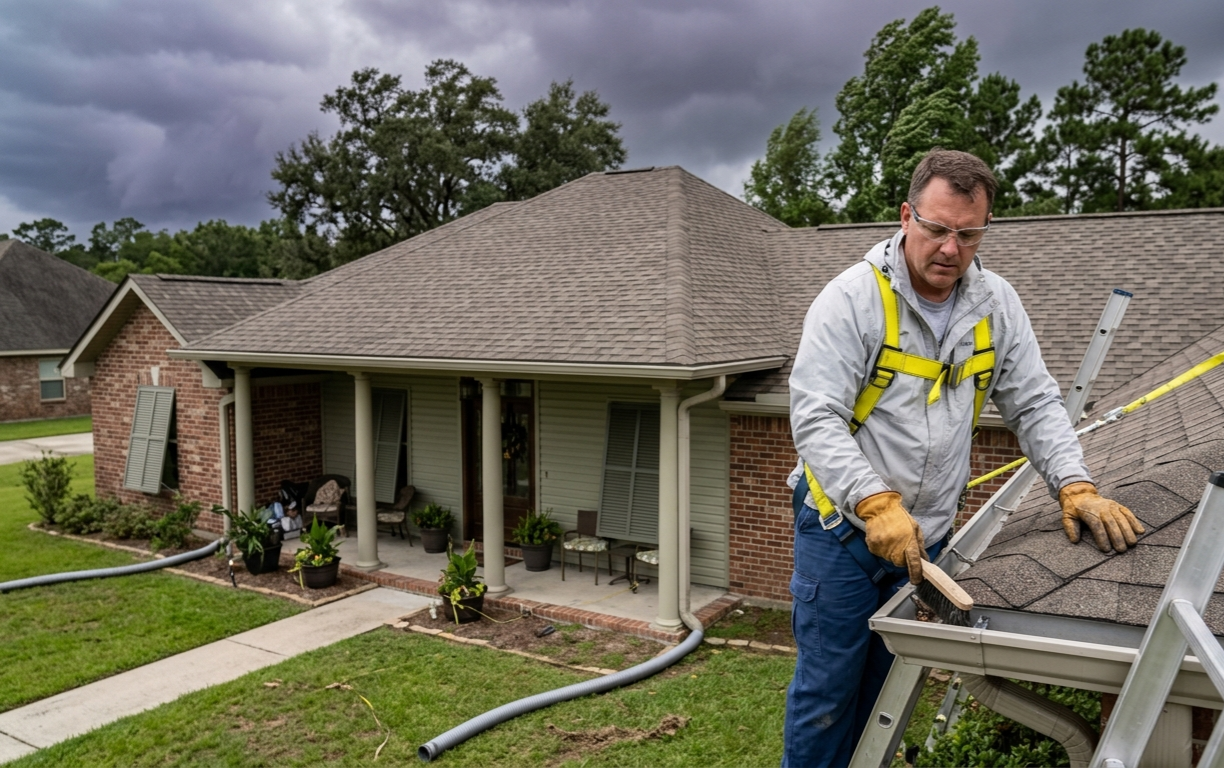
The work that has to happen early
Your roof is the part of the house that fails first, and it almost always fails at an edge. Wind gets under a lifted shingle at a rake or an eave, peels it back, and the exposure spreads from there. So the early work is about edges and attachment.
Have someone confirm that your drip edge is installed and secured, that the starter course at the eaves is a real starter strip rather than a reversed shingle, and that the ridge cap is fastened with nails long enough to reach the deck. On a roof over fifteen years old, ask specifically about the condition of the sealant strips that bond each shingle to the one below. Those strips are what resist uplift, and they lose their grip as the asphalt ages.
Soffits deserve more attention than they get. Vinyl soffit panels that are not locked into their channels will blow out in sustained wind, and once the soffit is gone the wind is inside your attic pushing up on the deck from below. That is how whole roof sections leave. Any lafayette roofing contractor doing a pre-season inspection should be checking soffit attachment as part of the walkthrough.
Garage doors are the other structural weak point. A double-width door that buckles inward gives the storm a large pressurized opening in the side of your house. Retrofit bracing kits exist for most door models and cost far less than the damage they prevent.
If you are already facing a replacement, look at the FORTIFIED route before you sign anything. The Louisiana Fortify Homes Program, administered by the Department of Insurance, offers grants of up to $10,000 toward upgrading a roof to the IBHS FORTIFIED Roof standard, which specifies a sealed roof deck, ring-shank nails, and upgraded edge metal. The program runs as a lottery in designated parishes rather than first-come-first-served, and the 2026 round opened June 1 and closed June 19. Check fortifyhomes.la.gov for the next window instead of assuming one is open. A separate state tax credit and, under Regulation 136, mandatory insurer discounts for FORTIFIED-designated homes run independently of the grant.
On the houses that lost whole sections after Delta and Laura, the failure often started at the soffit rather than the ridge. Once a panel blows out, wind gets inside the attic and pushes up on the deck, so the roof leaves from underneath. That is a condition you can check from the ground in ten minutes.
Water, which is the Lafayette-specific problem
Wind gets the headlines. Around here, water does more of the damage, and it arrives from two directions.
From above, your gutters and downspouts have to handle serious rainfall intensity. NOAA's engineering weather data for the region puts the 50-year recurrence rain rate at around four inches per hour. Standard five-inch K-style gutter with downspouts every 35 feet is sized for ordinary rain, not for that. If your gutters overflow in a regular summer thunderstorm, they will be irrelevant in a hurricane. Upsizing to six-inch gutter with three-by-four downspouts is a straightforward improvement, and adding a downspout is usually cheaper than replacing a run.
From the ground, check where your downspouts discharge. Water dumped next to the slab in a saturated yard has nowhere to go but down alongside the foundation. Extensions that carry runoff ten or more feet out, or a buried drain line to daylight, keep that water moving away.
Clear the storm drain or ditch at your street frontage before a system arrives. Parish crews cannot get to every one of them, and a culvert packed with leaves backs water into yards fast.
The 72-hour list
Bring in or secure everything that can move. This includes the things people forget: potted plants, the trampoline, the kids' basketball goal, propane tanks, and any construction material sitting in the side yard.
Trim nothing. Cutting branches two days before a storm leaves you with a pile of loose limbs and no way to dispose of them. Do that work in February.
Photograph the house inside and out and email the photos to yourself so they exist off the phone. Locate your insurance policy number and your deductible amount, because named-storm deductibles in Louisiana are often a percentage of the dwelling coverage rather than a flat figure, and people are frequently surprised by what that works out to.
Fill the bathtub, charge everything, and put a tarp, a staple gun, and a roll of plastic sheeting in the garage where you can reach them. If a limb comes through the roof, a temporary cover applied the same day is the difference between drying out a rafter and replacing a ceiling.
After the wind stops
Do not climb on a wet roof, and do not climb on any roof you are not sure is sound. Assess from the ground with binoculars, photograph everything, and call your insurer before you call anyone who knocked on your door.
Two Louisiana laws that took effect August 1, 2025 are worth knowing here. Act 144 prohibits contractors from advertising or soliciting as insurance claims specialists and from providing claim or policy interpretation services, and it bars public adjusters from performing construction work on claims they handle. Your roofer scopes and performs the repair. Claims handling belongs to a licensed public adjuster or an attorney. Act 239 requires permitting and inspection for roof construction and reroofing statewide, so a contractor telling you a reroof does not need a permit is telling you something that is no longer true.
Verify any contractor's license number directly through the LSLBC's public contractor search rather than taking a card at face value. As of January 1, 2026, residential roofing work valued at $7,500 or more requires a Residential Roofing or Residential Construction classification under Act 422.
Sources
- Act 144 (HB 121), 2025 Regular Session, résumé digest, Louisiana State Legislature: https://legis.la.gov/LEGIS/ViewDocument.aspx?d=1427858
- Act 239 and Act 422, 2025 Regular Session, summarized in LSLBC contractor memo, August 2025: https://lslbc.gov/wp-content/uploads/2025/08/Memo-Roofing-Contractors-Aug-2025.pdf
- Louisiana Fortify Homes Program, Louisiana Department of Insurance: https://ldi.la.gov/fortifyhomes
- LSLBC contractor license verification: https://lslbc.gov/contractor-search/
- NOAA / NCEI engineering weather data, Baton Rouge Ryan station: https://www.ncei.noaa.gov/pub/data/EngineeringWeatherData_CDROM/engwx/baton_rouge_la.pdf


Leave a Reply